

Shawn's blog
Open Thread: GEOS Honolulu No Longer Accepting Enrollments
Sat, 01/29/2011 - 15:25 — ShawnThis was mentioned in comments in a previous thread on GEOS, but the Honolulu school is no longer accepting students. The Honolulu page on GEOS.net looks like this:
When you go to GEOS.net, there is no mention of the Honolulu school anywhere on the page. So, by "no longer accepting enrollments" they mean "closed," right?
The University of Nova?
Wed, 01/05/2011 - 23:15 — ShawnThe last I checked, April 1st is still a few months away, but that's the question the Yomiuri shimbun asks in a brief article about G.communication's attempt at running a university.
According to the article, G.communication, through its largest shareholder, Inayoshi Capital Partners (ICP), is putting the final touches on plans to take over a private university in the Tokai region and may also involve changing its name to the University of Nova. The Yomiuri doesn't name the university, but I wonder if it isn't Aichi Gakuin University. Back in 2008, Nova opened a school on its campus.
While the Yomiuri calls the takeover of a university by an eikaiwa "extremely unusual" I'm going to go out on a limb and say it's unheard of. According to the Ministry of Education, Culture, Sports, Science and Technology, in order for a business to take over a university, it would have to fund the founding institution behind the university and then either send directors to the university's board or create a new education institution.
Why do this when the Nova brand is associated with fraud and a spectacular bankruptcy? The Yomiuri ends by noting that ICP, headed by Masaki Inayoshi, is thinking of creating such a new institution to facilitate the handover. Inayoshi would, of course, be in charge of this institution along with ICP and G.communication.
Does he really think he can run a university or is he doing this so he can say that G.communication is about higher education? If the University of Nova becomes a reality, would anyone want to study there? Would a degree from it be worth anything? I'm inclined to say, "No," but put me down for a University of Nova sweatshirt just for the sheer novelty of it.
The Year in Review
Thu, 12/30/2010 - 17:46 — ShawnThe kanji for 2010 was "sho"(暑)meaning hot. Looking back on the year, as far as this blog is concerned, the word of the year is probably "GEOS" owing to the closure of its schools in Australia and then its bankruptcy in Japan. On the other hand, if you worked for Nova when it collapsed in 2007, the fact that the trustees have started paying unpaid wages probably came as a pleasant surprise. For what it's worth, here's a recap of the issues covered on Let's Japan.
January
- Fortress Japan continued to rip-off its customers despite promising to end its strong-arm sales tactics.
- GEOS tries to spin bad press. Signs that the company's health was in question?
- GEOS Australia goes into voluntary administration despite the schools being profitable.
- GEOS Japan goes into damage control mode and maintains that the bankruptcy of the schools in Australia will not affect operations in Japan.
February
- Guideline 8, the "rule" stipulating that foreigners have to enroll in a national health insurance scheme when renewing their visa will not be implemented.
- GEOS Japan offers an apology for the closure of its Australian schools.
- Preliminary investigations into the school closures in Australia reveals some unusual transfers of money.
- It becomes clear that the Australian schools were financially sound and nobody really understood why they went under.
- The Consumer Affairs Agency finally shuts down Fortress Japan.
- China gets into the act warning its students about studying with GEOS.
March
- The Ernst & Young report on GEOS Melbourne, a profitable school, reveals that the school was bled dry through loans to a GEOS holding company that had no means to repay them.
April
- Charges of aggravated breach of trust dropped against Sahashi.
- ALT contracts in Chiba are deemed to be illegal.
- Despite its repeated claims that all was well in Japan, GEOS goes bankrupt. G.communication takes over its business.
- GEOS president Tsuneo Kusunoki claims that he was illegally ousted from the company.
- Adamu at MutantFrog take a look at the foreign language market.
- Kusunoki vows to take back GEOS.
May
- GEOS North America releases a statement that its doors are still open and that everything is OK.
- Former Nova president, Nozomu Sahashi, appeals his sentence for embezzlement and maintains that he did nothing wrong.
- Rumors surface that there was a coup at GEOS.
July
- The Consumer Affairs Agency releases report on how Fortress Japan ripped-off its employees.
- The Berlitz lawsuit drags on.
August
September
- Hiroshima-based David English House files for bankruptcy.
- Japan's budget cutters target the JET Programme on the chopping block.
- GEOS North America signs letter of intent with Florida-based Open Hearts International College for the acquisition of all 12 GEOS schools. As of this writing, it's not clear whether GEOS has been sold.
- Interac bought out by Advantage Partners.
October
- Sahashi back in court to have his appeal heard. He maintains that he is innocent.
- Masaki Inayoshi reclaims control of GEOS and Nova.
- Inayoshi Capital Partners re-brands some of its Geos schools as Nova X Geos and announces the closure of some non-performing schools.
- The process works: Nova teachers start receiving wages owed three years after the collapse of Nova.
November
December
- Nozomu Sahashi is sentenced to two years in prison for embezzling funds from an employee welfare fund.
Robots in the Classroom
Wed, 12/29/2010 - 13:51 — ShawnSome time ago I took a look at robot English teachers into the classroom:
Almost 30 robots have started teaching English to youngsters in a South Korean city, education officials said Tuesday, in a pilot project designed to nurture the nascent robot industry.
Engkey, a white, egg-shaped robot developed by the Korea Institute of Science of Technology (KIST), began taking classes Monday at 21 elementary schools in the southeastern city of Daegu.
While it is a pilot program, the reasons for the robots, apart from "it's technology and therefore cool," boil down to cost and humans are scary.
"Well-educated, experienced Filipino teachers are far cheaper than their counterparts elsewhere, including South Korea," he told AFP.
Apart from reading books, the robots use pre-programmed software to sing songs and play alphabet games with the children.
"The kids seemed to love it since the robots look, well, cute and interesting. But some adults also expressed interest, saying they may feel less nervous talking to robots than a real person," said Kim Mi-Young, an official at Daegu city education office.
[...]
"Having robots in the classroom makes the students more active in participating, especially shy ones afraid of speaking out to human teachers," Kim said.
[...]
The machines can be an efficient tool to hone language skills for many people who feel nervous about conversing with flesh-and-blood foreigners, he said.
Maybe I'm getting cranky as I get older, but the robots sound like nothing more than TVs on wheels. It's ironic that while the teachers are Filipinos, their avatars are Caucasian.
The robots, which display an avatar face of a Caucasian woman, are controlled remotely by teachers of English in the Philippines -- who can see and hear the children via a remote control system.
I'm also not convinced that a robot would help a student overcome their fear of talking with a real human. If you learn to speak English from a robot, don't you still have to deal with your phobia of talking to people?
Apart from cheap labor from the Philippines, it takes until the end of the article to find about the real savings:
"Plus, they won't complain about health insurance, sick leave and severance package, or leave in three months for a better-paying job in Japan... all you need is a repair and upgrade every once in a while."
No wonder teachers are leaving for better-paying jobs in Japan. How dare those pesky teachers take time off and demand better pay.
Sahashi Sentenced to 2 Years in Prison
Thu, 12/02/2010 - 23:13 — ShawnThree years after the collapse of Nova, there is finally some closure on the matter. Teachers are being paid after the Osaka High Court sentenced him to two years in prison for "corporate embezzlement."
The former president of English conversation school Nova was handed a two-year prison sentence for corporate embezzlement by the Osaka High Court on Dec. 2.
Nozomu Sahashi, 59, had been convicted of the offence by a lower court and sentenced to a three-year, six-month prison term in August last year. The high court decision on Sahashi's appeal confirmed his conviction for embezzling money from employees, but reduced the sentence as the funds were used to pay back customer deposits and Sahashi did not himself profit from taking the money. Sahashi intends to appeal.
While he intends to appeal, he doesn't appear to have a very strong case. Sahashi has long maintained that he took money from the Shayukai employee welfare fund to pay refunds and save the company. The problem with companies like Nova, where every aspect of their operation is controlled by the president, is that they have no concept of corporate governance. The company is theirs and any money in it can be used for any purpose. This is the essence of Sahashi's defense:
Sahashi's defense counsel argued that "The Shayu-kai did not exist as an independent entity, but was just one part of the company. The entire sum withdrawn was set aside for refunding customers, and thus was not embezzled." Furthermore, "If Nova had not been able to refund its customers, it would have gone bankrupt, and Mr. Sahashi fully intended to return the funds once the company attracted new investment."
That's some strange logic given that the game was over the moment Nova's fraud was exposed. Nova had close to $1 billion in debts and liabilities when it went bankrupt. Using the money from the Shayukai didn't stop the collapse. While Sahashi's lawyers did manage to knock 18 months off the sentence, I think it's safe to say that the final chapter of the story of Nova has been written, but like many drawn-out dramas, a lot of people will be disappointed with the ending.
Eikoh Buys Shane
Sun, 11/21/2010 - 13:41 — ShawnCram school operator, Eikoh Inc., has bought Shane English School.
Cram school operator Eikoh Inc. said Friday it has acquired Shane English School to strengthen its English-language education for elementary school children ahead of the planned compulsory teaching of the language for fifth- and sixth-graders.
Eikoh, based in the Kanto region, didn't disclose how much it paid for the acquisition of shares in the four operating companies that run the English school chain, which mainly operates in the Tokyo metropolitan area.
According to the announcement of the purchase [PDF] on Eikoh's website, Eikoh will acquire all shares in Shane Corporation Japan, Shane Corporation North Kanto, Shane Corporation East Kanto, and Shane Corporation South Kanto. While no price has been made public, a brief blurb in the Nikkei keizai shimbun says the deal was around 1 billion yen (about $12 million USD).

Back to the Japan Times article:
Representatives of both Eikoh and Shane English School said the acquisition won't involve personnel cuts or other drastic changes in operations.
A source I know says that Eikoh and Shane has been in negotiations for some time. Apparently the deal is only for Shane's schools in Japan and not those in China and Taiwan, which are much more profitable. I suppose the deal is a safe one for Eikoh since Shane sells more monthly lessons as opposed to year-long packages, so they aren't any large hidden liabilities. Eikoh bought Shane as a strategic purchase in anticipation of English being introduced in elementary schools next year and English lessons being taught entirely in English in high schools in 2013.
I wonder about the promise of no personnel cuts or drastic changes. The Japan Times notes that 60% of Eikoh's and Shane's schools are in the same location. I take this mean that many or most of the schools are in the same building, not just near each other in the same neighbourhood. In their announcement, Eikoh sees this as having a synergistic effect. It's publishing company, Educational Network, get a shot in the arm from Shane's business. Eikoh gets to conveniently sell English lessons at Shane to its cram school students. Moreover, with 40% of Shane's students being junior high school students or younger, they are perfect candidates for cram schools.
The promise of no drastic changes makes the last paragraph of the article funny:
Takehiko Kikuchi, a PR representative for Shane English School, said company employees and teachers received the news calmly.
Nobody freaked out. No worries, everything is OK. Mergers aren't necessarily bad things, but in eikaiwa, recent history shows that they are almost always bad news, as seen with G.communication's takeover of Nova and GEOS. Whether or not Eikoh's purchase pays off remains to be seen.
Small Successes
Tue, 11/02/2010 - 22:57 — ShawnWhen GEOS went under, I suggested that the event to the die-off of the dinosaurs where the large schools would give way to the uplifting and positive piece in The Japan Times on some thriving, smaller schools.(Pay no attention to the jaded guy he quotes throughout the article, though.)
For example, he describes Tower English, a drop-in school where mothers pay 500 yen a week to play games with their children. There is Primrose English School in Ibaraki Prefecture, a school built onto the owner's home that boasts plush carpets and warm colors. Another teacher offers tailor-made mini-courses.
What is common among all of the examples is that they have an angle. They have something unique to sell that fills a niche. Moreover, they are local and know their students, and have built up trust and goodwill. It's also important to point what they are not doing, and that's teaching in a Starbucks with photocopies from an old textbook. When you can sell yourself or your idea, you are in a position to thrive as opposed to simply getting by. And when you are in charge and calling the shots, you are doubly motivated to do a good job.
It's been a while since I've seen something positive about eikaiwa in the newspaper.
The Bottom of the Barrel
Mon, 11/01/2010 - 22:23 — ShawnTime to blow the cobwebs off this blog and talk about James McCrostie's article in the Japan Times two weeks ago on the General Union's scrap with Gaba.
The General Union says it has established a Gaba Branch and is accusing Gaba of lying when it stated in a financial report that there was no union and that labor relations were good. By all accounts in the article, this should be a slam dunk for the union, until you read this part:
The union declined to divulge how many Gaba instructors are members, citing a desire to keep the information from the company. Many members are undeclared, executives said, as they fear their contracts won't be renewed if they admit belonging to the union.
Unions don't work when they are a secret. Gaba can ignore the General Union and say that labor relations are good because they are probably just dealing with a couple of union representatives as opposed to a group of teachers from several schools demanding better working conditions. Frankly, if you are one delayed paycheck or one, "Sorry your contract won't be renewed" away from financial distress, you have bigger problems than unionization.
Instead of ranting about the pros and cons of trying to unionize eikaiwa, McCrostie's article should serve as a warning to anyone thinking of coming to work for Gaba. It's ironic that Gaba, a school that has boosted its fortunes in helping employees at Japanese companies become more global, technically has no employees itself since it maintains that its teachers are all contractors.
But if you were to read Gaba's recruiting website, you would have absolutely no idea what kind of labor nightmare awaits you in Japan. For all you know, you're a professional Gaba employee helping students achieve their goals, right? After all, the website talks about GabaWeb and its world-class methodology, texbooks, and technology, and how their certification is designed to help you reach your full potential. There are even opportunities for growth within the company.
Everything you read on that website makes it sound like you will be a valued employee. That is, until you actually arrive in Japan:
Employing instructors as independent contractors allows Gaba to reduce labor costs.
"There are absolutely no benefits and Japanese labor standards law doesn't apply," says Combs. Instructors receive no paid sick days or vacation, no pay for training, no overtime pay, and there's no limit on the number of unpaid overtime hours that can be worked. The company also avoids enrolling its instructors in unemployment insurance, the national health insurance and pension schemes, and workers' compensation. It also fails to pay a commuting allowance to instructors.
The instructors, working on six-month contracts, also lack job security. Employment as independent contractors means Gaba can dismiss any teacher, with or without cause, simply by not renewing their contract.
According to figures from the company posted on the G.U. website, pay for Gaba instructors ranges from ¥1,500 to ¥2,200 per 40-minute lesson depending on the instructor's status level and the time of the lesson. Most instructors fall into the bottom of the pay scale, with 502 out of 854 instructors receiving the minimum ¥1,500. Only 16 instructors earn ¥2,200 and Gaba caps the number of instructors that can be promoted to the higher pay brackets, the union says.
Promotions to a higher pay scale tend to be ephemeral, argues Ringin. "Basically, a pay raise is not a pay raise at Gaba; it's a temporary privilege, which they can take away more or less when they feel like it."
An instructor review committee evaluates each instructor monthly, Ringin explains. Receiving too many less-than-perfect scores on student evaluations, being late submitting your available hours, or calling in sick can be grounds for demotion to a lower pay scale, he says.
Incredibly, the article goes on to briefly describe a couple of teachers who, despite the above, actually like working there. I suppose it is good as long as you are oblivious to what's going on and don't care about yourself. Poor souls. Make no mistake, Gaba is the bottom of the barrel.
Open Thread: First Proportional Payments Due
Tue, 10/19/2010 - 06:46 — Shawn(see thread for larger images):
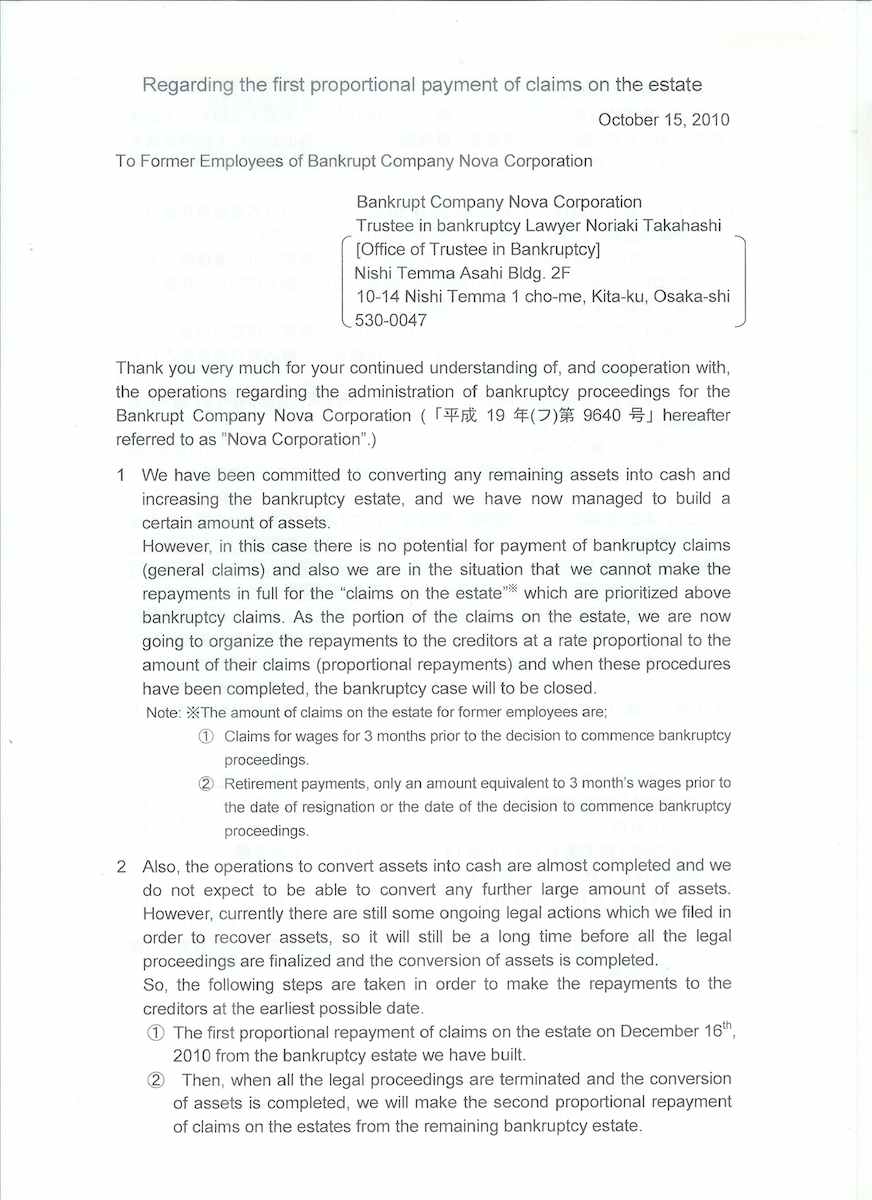

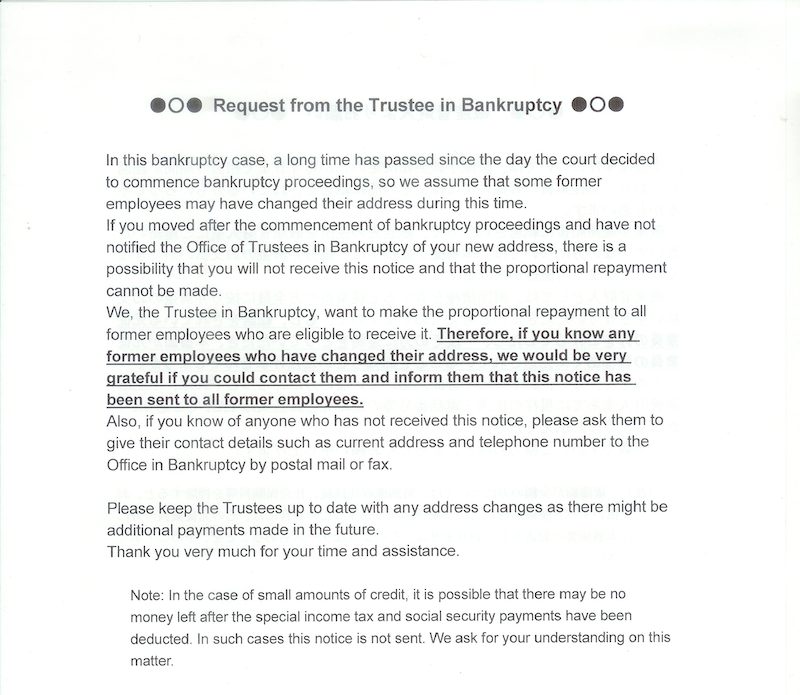
Others have also received letters saying they will be paid 82,000 yen, some less than that.
Old Wine in New Bottles
Fri, 10/15/2010 - 12:12 — ShawnHere come the school closures:
Nagoya-based investment fund Inayoshi Capital Partners said Thursday that about 50 of its 167 Geos foreign-language school branches will be renamed Nova X Geos after November.
ICP also said it will close down about 20 Geos branches whose business areas are overlapping with those of Nova.
The company said students of those schools will be relocated to the nearby Nova schools or receive lessons via Nova's unique video-phone system.
Nova X Geos? What the hell kind of rebranding is that? Two dodgy schools under one roof? Maybe titling this post, "Old Wine in Old Bottles" would have been better.
I'm sure the students will be ecstatic about having to move to another school or purchasing a videophone system. Still no word about what happens to the teachers, although it's clear that some will certainly lose their jobs. Would it kill the media to mention their part of the story?
LJ is currently using a spam filter, which may eat legitimate comments, particularly those containing URLs. If you are having trouble posting a comment, email LJ.

Recent comments
57 min 26 sec ago
1 hour 50 min ago
6 hours 22 min ago
8 hours 8 min ago
9 hours 56 min ago
10 hours 8 min ago
10 hours 11 min ago
10 hours 19 min ago
10 hours 29 min ago
10 hours 39 min ago