

Shawn's blog
GEOS Goes Bankrupt
Wed, 04/21/2010 - 13:58 — ShawnAdd GEOS to the list of eikaiwas that have gone bankrupt. GEOS filed for bankruptcy today, temporarily closing its schools until the 23rd when G.communication, the company that picked up the scraps when NOVA went bankrupt in 2007, will take over part of GEOS's business.
GEOS will close 99 schools (PDF), while keeping 170 schools and 66 GEOS kids (PDF) schools in operation.
In GEOS's own press release (PDF), it cited the recession and the collapse of NOVA in 2007 as significant factor that harmed its business, leaving the company with debts totaling 7.5 billion yen as of the end of March this year.
And that's the end of GEOS. Not being privvy to its finances, it was next to impossible to say when the end would come, although the cynic in me wondered how the closure of its Australia schools could not affect business.
After the collapse of NOVA, the fall of GEOS is yet another point on the graph of eikaiwa's long decline. That g.communication will take over GEOS comes as a bit of surprise. Given the poor condition of the English language market, how much blood do they think they can realistically extract from the eikaiwa stone?
Chiba ALT Conracts Deemed to be Illegal
Sun, 04/18/2010 - 06:45 — ShawnWhoever wrote :
Public schools here [Kashiwa, Chiba] have been unable to start their native speaker-taught English classes this school year after the city's board of education was accused of violating labor laws with foreign language teachers.
According to the Kashiwa Municipal Board of Education, it has been instructed by the local labor office to change its labor relationship with foreign assistant language teachers (ALTs) in the city's elementary and junior high schools after it engaged in illegal employment practices.
The local education board entrusted part of its English curriculum for primary and secondary school students to a Tokyo-based staffing agency between 2007 and 2009, and a total of 23 foreign teachers belonging to the agency worked as ALTs at 61 local public elementary and junior high schools during this period. Their contracts expired at the end of last month.
The article goes on to say that instructors were working as temporary employees under the guise of subcontractors, and demanding that their contracts be extended. When they complained to the labour board, the board investigated and found that the instructors were under the direct supervision of the schools they worked at even though they were working under dispatch contracts. The problem with this kind of arrangement is that:
Under the current law, companies and other business operators must offer a direct contract to their temporary workers after they have completed the first three years of work. Moreover, the Ministry of Health, Labor and Welfare's labor guidelines require a minimum three-month interval before the two parties enter into another temporary contract.
The city's board of education had planned to terminate its English class teacher outsourcing contract and employ temporary English teachers directly starting this April. However, as the labor office judged that the education board had already forced its contracted foreign teachers to work as normal temporary staff, it became impossible for the city to renew the contracts right away, in accordance with the ministry guidelines prohibiting consecutive temporary contracts of over three years.
The BOE has announced that it will comply with the labour board's order, although English classes have been suspended until July. This is a good first step in breaking what I called "the terrible triangle" in ALT teaching jobs. The complaints to labour boards are having an effect.
Open Thread: GEOS Scuttlebutt
Thu, 04/08/2010 - 05:49 — ShawnDiscussion about GEOS continues here. Two recent developments within GEOS appear to be the sale of three schools in the UK and the planned closure of 84 schools in Japan between May and November.
News of the sale of the UK schools is here:
From Thursday April 1st 2010, the three GEOS UK schools in London, Brighton and Eastbourne plus ELS Paris are no longer part of the GEOS network. The four schools have been bought from GEOS Corporation in a management buy out by Wendy Teraoka (previously Regional Director, GEOS Europe) and Paul Clark (previously Principal of GEOS-LTC Eastbourne).
We will shortly be rebranding our three schools. ELS Paris will remain Executive Language Services (ELS).
The 3 UK schools will be Language Teaching Centres UK:
- LTC London
- LTC Brighton
- LTC Eastbourne
The announcement of school closures in Japan can be found here. It appears that the pace of GEOS's restructuring has quickened as they plan to scale back to 185 schools.
Harrassed by the Police in Shibuya
Thu, 04/01/2010 - 21:51 — ShawnFrom :
This happened today 29/03/2010
I was stopped by 5 police officers as I was standing outside a ramen shop. An older police officer asked me if I had eaten ramen, I simply ignored him and gave him a blank stare. A female officer then requested that I show my passport. I gave her my gaijin card, and she read out that I was from England. The older officer tugged my bag and wanted to search it. I did not like being surrounded by police, and asked him if he had a search warrant in Japanese.
This stunned him and he replied by asking how I knew such a word. I did not move and he tried too reach for my bag. I told him again that he needed a search warrant. The officer then went behind me and pulled off my bag, and started to empty it's contents. They found some incense that I had purchased and rolling papers.
This is when the real problems started. I was taken to the small koban and they removed my jacket, hooded fleece and also tried to take off my t-shirt (in public view). I stopped them from taking off my t-shirt. They took me to a room inside the koban and had me remove my belt, which the same old officer would not let me have back. I then was told to sit as they went through my belongings. He accused me of taking drugs, I said that I had done no such thing! A female officer (Nakajima Yuka) then told me to remove my shoes and socks, which I did.
After, they drove me to the big police station in Shibuya for interrogation and drug testing. A small detective dressed in black sat me down and tested the incense. Surely enough, it came out as negative. They then asked why I was carrying rolling papers, I said I like to smoke roll up cigarettes if I run out of tobacco at home. They then made me sign (fingerprint) numerous forms giving them permission to take the incense and also a urine test. The forms were voluntary, so I asked them what would happen if I refused to give my urine sample. Another detective (sorry for not taking names, there were 8 police officers in the room at the time) told me I would be taken to the hospital where a very painful procedure would be performed to take the urine by force.
I gave the sample, as I had finished, they brought in an officer who was bald (as am I) and said 'He is your brother!'. I did not find it amusing, I really wanted to get the hell out of there.
They performed the test in front of me and it came out negative (surprise surprise!). The whole ordeal took around 3 hours, and I pushed them to give me a lift to where I was going which they did.
The worst part I have to say was the initial stop... I never expected them to pull my bag and off and take everything out. Then the big shot detective sitting in front of me with his drug testing kit, and more police piling into the tiny ass interrogation room to see if the gaijin will go to prison... He actually said it maybe 'cocaine or heroin' after it turned out negative! I started laughing which made him bark at me in Japanese.
Same with the urine test, maybe 8 or 9 police officers all stood inside as they waited for the result, it came out negative.
The one thing I did regret was signing the papers. I always promised myself not to do so, but the way they did it was 'do this or you will not leave this police station'. They did not stop boasting about Sakae Noriko being brought in, and how she paid 5,000,000 yen bail. Poor woman must have been so relieved to get out.
At the end there was no apology of any sort, they said I should not buy incense that is not well known! The big shots went back to their PCs and laughed amongst themselves. I really wanted to get a hold of the police offenders that searched me in the first place, they were absolutely racist in the way they treated me, and quite proud of the fact too.
GenieZero also adds this information about himself:
I'm Pakistani in origin, I was dressed in casual street clothes, jeans,sneakers and jacket. I can speak enough Japanese to get by and I can understand it alot better than I speak. And I'm 25, but due to my shaved head I probably look older to most Japanese. Louis Carlet told me that I was not stopped because of my race but simply because I an not Japanese, I like to believe that as the former would infuriate me.
I'm also 6'3 so that also may have given them reason to be intimidated enough to prompt a search.
It just so happens that Debito met with the Special UN Rappoprteur for Human Rights of Migrants, Jorge A. Bustamante, where he spoke about how non-Japanese are treated in Japan. The folder he gave to Mr. Bustamante is full of information on the abuse of police power and racial profiling of non-Japanese.
This shit has to end. Fortunately, genieZero has reported the incident and it has apparently been forwarded to Amnesty International. It's possible that resisting the police's illegal search may have invited more trouble for genieZero, but on the other hand, police abuse of power won't end if people resign themselves to the fact that they cannot effect change.
Charge of Aggrevated Breach of Trust Dropped Against Sahashi
Thu, 04/01/2010 - 12:14 — ShawnThe Yomiuri Shimbun reports that the charge of aggravated breach of trust leveled by the Nova administrators against former Nova president, Nozomu Sahashi, has been dismissed.
According to the report, the Osaka District Public Prosecutors dropped the case due to insufficient evidence. Although Sahashi admitted to using the telecommunication company (Ginganet) he owned to sell massive quantities of unwanted videophones to Nova, Public Prosecutors deemed that there was no intent to cause harm as Sahashi never pocketed any of the money from the sale of the videophones.
Sahashi is still appealing his embezzlement conviction.
Yomiuri Shimbun
特別背任容疑で告発のNOVA元社長、不起訴
英会話学校「NOVA」(大阪市、破産手続き中)に約21億円の損害を与えたとして、破産管財人から特別背任容疑で告発された同社元社長・猿橋(さはし)望被告(58)(業務上横領罪で有罪判決を受け、控訴中)について、大阪地検特捜部は不起訴(嫌疑不十分)とした。3月31日付。
猿橋被告は、自ら実質経営する通信事業会社から、不要なテレビ電話機を、NOVAに大量に仕入れさせて損害を与えたなどとして告発されたが、特捜部は猿橋被告に資金が渡っておらず、損害を与える目的もなかったと判断した。
(2010年4月1日11時15分 読売新聞)
Why GEOS Melbourne Shut its Doors
Tue, 03/09/2010 - 07:00 — ShawnThanks to a kind reader, I received a copy of Ernst & Young's report to creditors on the closure of GEOS Melbourne. Many comments have been made about how GEOS siphoned its Australia schools dry, and the report offers an explanation as to how that happened. I've summarized key parts of the report to illustrate why GEOS Melbourne suddenly went into voluntary administration.
First, let's deal with the question about ownership of the GEOS Australia schools. When GEOS Japan issued its "apology" in February, it tried to downplay the affair by saying that the schools were locally incorporated businesses, that the decision to close was made locally, and that none of this affected GEOS Japan. The first two reasons may technically be true, but when it comes to that last one, the Ernst & Young report leaves you wondering how the closure of GEOS Melbourne and all of the other GEOS schools in Australia can't have anything but a negative effect on GEOS Japan. As of February, 23, 2010, the date of the report, Appendix A on page 30 carries this organization chart (click for larger image):
The GEOS Australia schools may be locally incorporated, but they are be 100% owned by GEOS Japan. Furthermore, the report states that as of October 15, 1996, Tsuneo Kusunoki was one of GEOS Melbourne's directors and that:
GEOS Melbourne is a 100% owned by GEOS Corporation (Japan). GEOS Corporation owns all 100,000 fully paid $1 shares in the Company (p.6).
The sudden closure of the school is curious given its recent performance. The table shows that the school's revenues had been increasing since FY07 (p.6).
The report notes:
GEOS Melbourne has been operating profitably for the previous two financial years (FY07 and FY09) as well as for the 6 months to 31 December 2009. Steady growth in profits has been seen due to growth in revenue coupled with a decrease in marketing, teaching and administration expenses as a percentage of revenue. (p.7)
Melbourne was profitable for the past two and a half years right up until its closure. Here's GEOS Melbourne's balance sheet.
Of concern here are the Receivables - Loan GEOS Australia Holdings and Receivables- Loan related entities under Non-current assets, and Dividends Paid under Equity. It is the loans to GEOS Australia Holdings which are at the heart of why the school closed.
Receivables - Loan GEOS Australia Holdings
The Victorian Regulation and Qualification Authority (VQRA) stopped the Melbourne school from accepting new enrollments in December 2009 after investigating an accounting report prepared for it by GEOS Melbourne. The departure of senior management personnel and the change in student enrollment hurt the school's revenues in the first half of FY10. The report goes on to say:
During the same period, a umber of other entities in the GEOS Australia Group were experiencing financial difficulties. This led to the directors to begin to understand that the ability of all companies in the Group to repay outstanding intercompany loans may be compromised. Without the repayment of these loans, the Company could not cover future obligation. It was on this basis that the directors appointed the Administrators.
The majority of excess cash generated from the operations of GEOS Melbourne appears to have been used in one of three ways, payment of dividends, loans to related entities and retained in GEOS Melbourne's bank account (p.10).
This table shows that much of the money went to other GEOS-related entities (p.10).
The Ernst & Young report concludes:
The ability of the related parties to re-pay the loan amounts outstanding was crucial to the ability of GEOS Melbourne to continue to trade. Without the repayment of the above loan, or the ability to raise cash from other sources, GEOS Melbourne did not have sufficient funds to continue operations (p.11).
The dividends of $633,755 and $1 million were paid by Melbourne GEOS to GEOS Japan (p.10). They were not cash payments, but a reduction in the balance of the GEOS Australia Holdings loan (p.11).
Receivables - Loan related entities
As for money that went elsewhere within GEOS, the report lists the following amounts (p.13):
The Administrator's comment on the money:
On 4 February 2010 the Administrators issued a demand on GEOS Australia Holdings in relation to the debt payable to Melbourne. Given that GEOS Australia Holdings did not operate in its own capacity other than to act as a holding company for other members of the GEOS Australia group, the Administrators questioned the ability of GEOS Australia Holdings to repay the outstanding amounts. Further, it is also the Administrator's understanding that a large amount of the funds provided to GEOS Australia Holdings were further lent to other GEOS entities globally and as such may not be readily available for repayment.
A similar situation exists for the amount outstanding from GEOS Cairns Pty Ltd (administrators appointed). The Administrators were also appointed to this company on 29 January 2010.
As such, the Administrators have estimated the realizable value of these assets as nil (p.13).
According to the Administrators, a school that was profitable for the past two and half years was making loans to a GEOS holding company with no prospect of those loans ever being repaid. The money is gone, funneled back to Japan and to other parts of GEOS.
Another interesting tidbit in the report is that upon taking over GEOS Melbourne, the Administrators met with representatives of GEOS Japan and related entities in Australia to discuss whether money would be made available to the Administrators so they could reopen the school. GEOS Japan gave them no money. The Administrators were forced to announce the closure of GEOS Melbourne to staff and students on February 1. For whatever reason, GEOS Japan chose to not bail out a profitable school.
Investigations
Apart from trying to rehabilitate GEOS Melbourne, the Administrators also investigated the school's business to understand the circumstances of its failure and form an opinion as to how it would act in the interests of GEOS Melbourne's creditors. Under the Corporations Act, the Administrators identified seven offenses that warranted further investigation.
- Failure to exercise reasonable degree of care and diligence
- Failure to act in good faith
- Making improper use of position to gain advantage
- Making improper use of information to gain advantage
- Reckless or intentional dishonesty in failing to exercise duties in good faith
- Failure of director to disclose interest in contract with company
- Being a director at the time when an insolvent company incurs a debt and there are reasonable grounds for suspecting the company to be insolvent. (p.18)
In examining the actions of the directors, the Administrators believe making loans to GEOS Australia Holdings to be a breach of good faith as GEOS Australia Holdings had no means to repay those loans (p.19). Those loans left GEOS Melbourne with insufficient funds to operate.
The Administrators identify $2,273,975 in uncommerical transactions, transactions that have no benefit or are detrimental to the company. Of that amount, $725,521 went to GEOS Australia Holdings and $1,144,500 to GEOS Japan, with the remainder going to other GEOS entities ($220,000) and a $1 million dividend. Here's a breakdown (p.21-22):
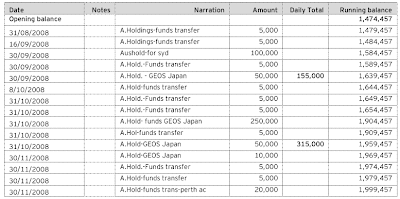
The Administrators concluded that GEOS Melbourne received no benefit from these transactions and that the loans left the school with no money to continue operations (p.22).
On the other hand, the Administrators found that GEOS Australia Holdings did benefit from the loans and may have become insolvent had it not received the money since it had no other means of generating income. The Administrators still do not understand the purpose of the loans but believe that "…in the past 18 months, approximately $1.36m was made available for the purposes of transfer from GEOS Australia Holdings to GEOS Corporation (Japan) or other GEOS entities (p.23)." Unfortunately, the Administrators feel that recovering the money from GEOS Japan is unlikely due to the cost involved, but think that going after the related companies may be worthwhile. However, without funding from creditors it doesn't appear that the money will ever be recovered.
Unreasonable director-related transactions (UDRT)
The report notes that some transactions between with GEOS Australia Holdings may be UDRTs as the directors of GEOS Melbourne are also directors of GEOS Australia Holdings, and one director of GEOS Melbourne is director and chairman of GEOS Japan (p.23).
Insolvent trading
The Administrators ask two questions:
- How likely were the loans made to GEOS Australia Holdings to be paid back?
- Is it reasonable to assume that GEOS Australia Holdings was insolvent? (p.24)
This matters because GEOS Australia Holdings' net assets over the past three years was negative. If it was trading while insolvent, the actual date the loans was considered unrecoverable needs to be determined in order to take action against the directors (p.25).
However, the directors did place GEOS Melbourne into voluntary administration when they were aware that the money from GEOS Australia Holdings would not be recovered, so they may have a valid defense against any recovery action. Although it appears that GEOS Australia Holdings was insolvent for some time, further investigation is required to determine the point it became insolvent .
The dividend
As already noted, a dividend of $1 million was paid to GEOS Melbourne's shareholder, GEOS Japan in the form of a reduction of the outstanding loan from GEOS Australia Holdings (p.25). Since no cash was involved, there is nothing to be recovered. The Administrators also note that by law, dividends may only be paid out of profits and that statutory and common law principles have to be applied in assessing whether or not the dividend complied with the law.
Recommendations
The Administrators are of the opinion that their appointment should be terminated, that GEOS Melbourne is insolvent, and that it should be wound up by the Court. They recommend that it is in the interest of creditors to place GEOS Melbourne into liquidation (p.26). However, as of this report, the Administrators believe that there will be insufficient funds to pay any unsecured creditors (p.27).
That's the bulk of the report. The money funneled off the Japan will likely never be seen again and GEOS Melbourne doesn't have any assets of value with which to pay off any creditors.
Open Thread: GEOS Oceania
Sun, 03/07/2010 - 19:23 — ShawnA few readers asked for a separate thread for discussion about GEOS Oceania given recent developments. Good idea. Use this thread for discussing GEOS Oceania.
Guideline 8 Officially Deleted
Thu, 03/04/2010 - 16:31 — ShawnIf you haven't heard by now, the Immigration Bureau has officially deleted Guideline 8 and replaced it with:
"In order to promote signing up for social insurance, we will ask (foreign residents) to present their health insurance card starting April 1. We will not reject renewal or change of visa status for failing to present the card."
In other words, if you aren't enrolled in shakai hoken or kokumin kenko hoken when you go to renew your visa this year, your application will not be refused nor will they try and boot you out of the country.
The headline to The Japan Times article--Foreigners get nod to skip social insurance-- is misleading because the deletion of Guideline 8 has nothing to do with being able to opt out of social insurance. While the Free Choice Foundation is celebrating this as a victory, the law of land still obligates you to enroll in a national health insurance plan. While you'll get your visa, Immigration is still going to ask to see your health insurance card anyway.
For more, Hoofin has been all over this issue (and Ronald Kessler's case) and his latest is worth a read.
The Problem With Dispatch ALT Jobs
Thu, 03/04/2010 - 12:42 — ShawnThe Fukuoka General Union has a long read titled The ALT Scam that points out the problems with BOEs outsourcing ALT jobs.
The main points are:
- ALT jobs have been deemed a "service" so local governments can save money and avoid the management of foreign employees.
- It is illegal for sub-contracted ALT teachers to work at public schools
- ALTs/Dispatch companies don't know if they will get the next job/contract
- Most ALT jobs advertised will not eventuate because they do not exsist and nobody knows if they will eventuate
- Dispatch companies take big margins and the more they squeeze the ALT the more profit they make
- Sub-contract ALTs are in reality double taxed losing 5% to consumption tax
- Dispatch companies make profits from not enrolling ALTs in SH
- A sub-contract ALT has practically no recourse if the school deems them sub-standard
- BOEs ignore the Ministry of Education directive to employ ALTs directly
- The BOE has no way of knowing if the dispatch company is breaking labour laws
Get a cup of your favorite beverage and read it all...
Open Thread: GEOS Discussion
Mon, 02/22/2010 - 14:52 — ShawnSince there are more than 300 comments in the GEOS Rumours thread, I've decided to close the thread and start a fresh one here.
LJ is currently using a spam filter, which may eat legitimate comments, particularly those containing URLs. If you are having trouble posting a comment, email LJ.

Recent comments
56 min 40 sec ago
1 hour 50 min ago
6 hours 21 min ago
8 hours 7 min ago
9 hours 55 min ago
10 hours 7 min ago
10 hours 10 min ago
10 hours 18 min ago
10 hours 28 min ago
10 hours 38 min ago