

Shawn's blog
Follow the Money
Tue, 02/02/2010 - 21:48 — ShawnBack in 2001(my emphasis):
Around 20 companies affiliated with English-language school operator GEOS Corp. failed to declare some 280 million yen in income in the five years to March 2000, industry sources said Thursday.
This total includes 130 million yen in concealed revenues, the sources said.
Auditors at the Tokyo Regional Taxation Bureau who investigated the Tokyo-based company also found that GEOS President Tsuneo Kusunoki and his wife, who serves as vice president, failed to report more than 200 million yen in personal income in the three years through 1999, they said.
Kusunoki is suspected of obtaining part of the affiliates' undeclared income for his personal use, the sources said.
Today's The Age:
Industry insiders said the global financial crisis had hit GEOS hard and its Japanese operations were in trouble.
Even before the appointment of administrators, the Victorian education regulator had been in talks with GEOS to set up a trust fund and other arrangements that would have secured funds in the Melbourne business.
The Victorian Registration and Qualifications Authority had become concerned about GEOS following a financial audit.
The authority's director, Lynn Glover, said in a statement: ''The VRQA had discovered that the directors [two Australian and one Japanese] have been diverting revenue from GEOS Melbourne to support the operations of other holdings in both Australia and overseas.''
Do you see a connection here? What will GEOS have to say if the administrators Down Under start finding some unusual money transfers? Remember, GEOS was quick to disown its Australian schools and say that everything is fine in Japan.
News coverage in Japan has been sparse so far, sticking to regurgitating the basic facts: eight schools closed, thousands of students affected, Ernst & Young are the administrators. What's not being reported is GEOS Japan siphoning money out of its overseas schools. Jiji.com simply notes that the schools ran into financial difficulties (資金繰り悪化). Things, however, are not that simple.
This is the destruction wrought by the closures:
Bill Egerton, who is contracted by GEOS to pick up foreign students for the Surfers Paradise school in his Koala Blue bus, said: "The receivers walked in and told everyone to leave. They have closed the doors. I'm owed about $4000 from them."
Mr Egerton said there were about 260 students at the school.
He said 15 students were due to arrive this weekend but would have nowhere to go.
"These kids pay $10,000 to $15,000 each for tuition."
AUSTRALIA'S international education industry has suffered another massive blow with the collapse of eight English language colleges, leaving 2300 foreign students around the country in the dark over their future.
The single largest group affected is in Melbourne and has an estimated 530 students unable to complete their courses. Some had just one more week before the end of their course. A total of 390 employees have lost their jobs.
[...]
Marcio Alves, 33, from Brazil, who paid $4000 and was expecting to finish his course in five weeks, said: ''I think I lost money here. In Brazil I worked for one year to save for this course.''
Pascal Fux, 40, a banker from Switzerland, paid $10,000 and said he had come to Australia in the hope of starting a new life. ''It's a country where everything should work fine, like in Switzerland … but this is a bad way to start a new life.''
Students and staff are owed more than $10 million in pre-paid fees and entitlements.
Worst-hit are about 1000 students who had paid GEOS for homestay accommodation and who could now face eviction.
GEOS student Joachim Adam from Germany has already been told by his landlady in Melbourne to immediately pay his weekly rent of $220 dollars or leave, even though he has already paid all his rent to GEOS.
"I must pay by this evening or I must go," he said.
Administrator Justin Walsh of Ernst and Young said remaining funds "are vastly insufficient to continue trading". GEOS was put into administration by its Japanese parent on Friday.
The Australian understands students, landlords and agents could be owed about $10 million, while the entitlements of the nearly 400 staff also run into the millions.
[...]
Mario Galindo, a 39-year-old university tutor from Colombia, paid almost $7000 for a ten-month course to improve his English. He has been left stranded with two months tuition owed.
"I thought this was a serious country . . . but now I think it was a mistake," Mr Galindo said.
Pina Vigo of West Preston in Melbourne was yesterday showing her newly arrived nephew, Filippo Zilio, from Italy, where his GEOS college was, only to find it closed. Mr Zilio, 19 had paid for a month's study.
"It stinks," Ms Vigo said. "How can they do this to the students? How can the government not know?"
This is what could be coming to Japan's shores very soon. Unlike Nova, there are no court cases to follow, no share price to monitor, and virtually no reporting in Japan. GEOS is a privately-owned company and isn't obligated to show its books to the public. If bankruptcy is in the cards, I think the end could happen quickly. There won't be months of drama unfolding on TV as with Nova's collapse. Staff and students could wake up one day to find the schools locked and shuttered.
If you work for GEOS, you have to start asking yourself, "What am I going to do if the shit hits the fan?" You need to start preparing for the worst. If you don't believe that bankruptcy will happen, ask yourself, "How long can I keep working for a company that operates with complete disregard for the well-being of its staff and students and still sleep at night?"
GEOS's Non-Apology
Tue, 02/02/2010 - 21:30 — ShawnGEOS Judas president and CEO, Tsuneo Kusunoki has issued an apology for the closures of the eight schools in Australia. Sadly, like the brief blurb on the GEOS website a couple of days ago, Kusunoki tries to assure everyone that things are OK while denying any connection to the schools. The apology in Japanese can be found here [PDF]. Here's a quick and dirty translation.
I want to express my sincere apologies to the students, those hoping to study with GEOS, and everyone involved for causing so much anxiety regarding the placement of all eight Australia schools under voluntary administration with Ernst and Young as its administrator. All of the schools in Australia are locally incorporated companies whose management, operations, and financial situations are completely independent. The decision [to close the schools] was made locally by the management. The use of the GEOS name was licensed to the schools. While there has been much concern, GEOS's schools in Japan and abroad, with the exception of Australia, are operating as usual. To the students and those involved in Australia, the Australian government will soon announce measures to address the situation. To GEOS students on study abroad and homestay programs in Australia, every effort will be made to prevent further inconvenience. I want to express my sincere apologies for the inconvenience caused.
Reading between the lines, I get the sense that he's saying that none of this is his fault. Do you feel reassured?
Somewhere, a rooster is getting ready to crow three times.
Guideline 8 to be Deleted
Tue, 02/02/2010 - 19:14 — ShawnGood news if you're worried about the possibility of your visa renewal being denied due to your lack of national health insurance coverage:
The Immigration Bureau is planning to change a new guideline for foreign residents to ease concerns that those without social insurance will be forced to choose between losing their visa and entering the insurance system, a bureau official said Monday.
[...]
"The bureau will delete item No. 8 by the end of March, and 'lightly mention' the need to present a health insurance card in the introductory passage of the guideline," Immigration Bureau spokesman Yoshikazu Iimura told The Japan Times. "The wording will be in a manner to eliminate foreign residents' concerns that their visas won't be renewed if they don't have insurance."
So now the Immigration Bureau will "lightly mention" that you should be
enrolled in shakai hoken or kokumin kenko hoken. Curiously, the article passes off the change as a victory:
Foreigners and their supporters have protested the new
guideline as an infringement on freedom of choice.
therefore should not preclude the possibility of choice. " It makes you wonder if Kessler helped Minoru Masutani write the article.
However, the deletion of Guideline 8 is in no way a victory for free choice. It's worth restating that nobody is being denied healthcare. It is your right to enroll in SK or KKK. You need to claim that right by asking your employer to enroll you in shakai hoken or enrolling yourself in kokumin kenko hoken.
GEOS Australia Schools Permanently Closed
Mon, 02/01/2010 - 22:37 — ShawnThe Victorian Registration and Qualifications Authority (VRQA) says it will protect the 2,300 students affected by the possible closure of a number of English language schools across Australia.
[...]
"If a decision is made by the administrators for the college to close, all overseas students will be protected by the tuition insurance scheme," she [Lynn Glover, director of the VRQA]said.
"This will mean that students will be placed in suitable alternative courses, here in Melbourne, at no additional cost and the VRQA will be supporting that process."
The voluntary administrators of eight English language schools say that the schools will not reopen because of the financial situation.
Justin Walsh and Adam Nikitins of Ernst & Young say they are working with the federal department of education and state government departments to find arrangements for the 2300 international students.
The administrators were continuing to investigate the nine companies operating under the GEOS name and hope to provide a further update on Wednesday, Ernst & Young said in a statement on Monday.
"We've very quickly worked through the options to keep the schools open, but were unable to do so," Mr Walsh said.
"That included speaking with the Japanese parent."
The interesting bits, however, are this:
The authority discovered that directors of GEOS have been diverting revenue from its Melbourne business, to support the operations of its other companies both in Australia and overseas.
And this:
But it is believed the GEOS group owes creditors tens of millions of dollars and will struggle to operate without significant help.
Back in Japan, GEOS is trying to downplay the closures and act as if nothing has happened. GEOS schools in Australia in trouble? We don't know what's going on. They just use our name under license. Everything is fine in Japan.
This just doesn't pass the smell test. How is it that eight schools, all taking in new students and seemingly operating without a problem, suddenly close and end up in voluntary administration overnight?
How do you distance yourself from the Australia schools while taking their money? What will GEOS say if the administrators in Australia find what they think are unusual money transfers? GEOS Australia and GEOS Japan may be two separate legal entities, but they are connected by the GEOS brand--a brand that is quickly tarnishing.
What does it say about the company when they post a few measly lines on their website saying everything is OK and not to worry? More information would do much to squash rumours about the company's health and mollifying any complaints its customers may have.
But it's too late for that. The schools won't be re-opening. As a student or employee of GEOS, you can't help but wonder if this isn't Nova all over again.
Damage Control
Sat, 01/30/2010 - 19:54 — ShawnThe story of the GEOS Australia schools shutting down has started to make the news in Australia and Japan. From Perth Now:
EMOTIONAL scenes erupted outside a Perth language school today after it closed unexpectedly due to financial problems.
Dozens of foreign students, who have already paid thousands of dollars for courses, were still arriving for night English classes at St Mark's International College in Perth tonight.
The school is one of eight language schools across Australia, owned by the GEOS group, that went into voluntary administration this afternoon.
About 2300 foreign students are currently enrolled across the nation, facing an uncertain future.
Some students could be forced to return home if the terms of their visas have been breached because they are unable to take part in full-time study.
At this point, the students don't know what's going on or what to do.
"Employees, students and creditors will be advised as soon as possible,'' the administrators said.
One student said she had paid $3000 for a three-month English course, while another stood to lose $11,000 for a 12-month course.
Students huddled together outside the college tonight, unsure of what the future held for them.
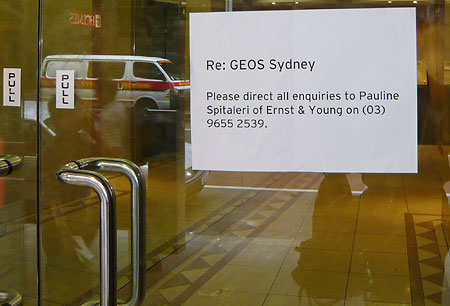
Source: Jiji.com
GEOS seems to have quickly gone into damage control mode. You wouldn't know this by looking at the GEOS website, however. At the time of writing, GEOS had very short blurb saying that the closure of the Australia schools doesn't affect operations in Japan.
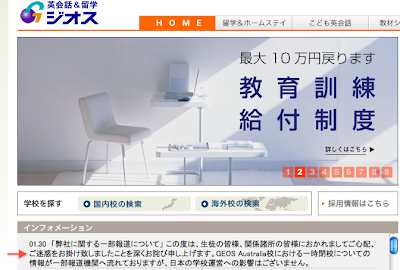
We're sorry for the trouble caused but don't worry, the problems in Australia don't affect GEOS in Japan. That's it? Not very reassuring if you're a paying customer. An anonymous commenter adds a bit more details by posting an internal memo (I can't verify it's authenticity).
Like the short blurb on the website, the memo tries to clarify the situation and reassure staff by saying that operations in Japan are not affected by the closures as the schools in Australia are separate entities from GEOS Japan and use the GEOS name under license. The memo goes on to say that lessons will continue for GEOS students studying abroad, except for Australia, and that it is currently trying to contact other students studying at its schools in Australia.
I didn't know that the Australia schools were not part of GEOS Japan. Even if their voluntary administration doesn't affect GEOS in Japan, it's a massive blow to the company's image. The collapse of Nova was only two years ago, and the clusterfuck that it created must weigh heavily upon management's mind. If they're trying to engage in damage control, they're off to a poor start.
Eight GEOS Australia Schools in 'Voluntary Administration'
Fri, 01/29/2010 - 19:11 — ShawnAdd this to the list of GEOS's woes: voluntary administration.
Eight English language schools operated in Australia by the GEOS group have gone into voluntary administration, leaving about 2300 foreign students unsure of their future.
Justin Walsh and Adam Nikitins of Ernst & Young have been appointed administrators to nine companies operating the schools in Melbourne, Sydney, Adelaide, Perth, Brisbane, Gold Coast and Cairns.
They have about 390 employees and international students from a number of different countries.
"The financial position of the companies is such that the directors appointed voluntary administrators," Mr Walsh and Mr Nikitins said in a statement on Friday.
"School operations have been temporarily suspended while the financial situation of the companies and ability to fund future operations of the schools is assessed over the next few days."
Voluntary administration is like Chapter 11 in the United States or corporate rehabilitation in Japan. In other words, they are effectively bankrupt. The eight schools affected are: GEOS Melbourne Pty Ltd, GEOS Adelaide Pty Ltd, GEOS Sydney Pty Ltd, GEOS Cairns Pty Ltd, GEOS Gold Coast Pty Ltd, GEOS Perth Pty Ltd, GEOS Brisbane Pty Ltd, GEOS Management Services Pty Ltd, and GEOS National English Academy Pty Ltd.
The administrators said a better understanding of the financial situation and a decision on future operations should be known by the close of business on February 1.
"Employees, students and creditors will be advised as soon as possible," they said.
It will be interesting to see what the administrators learn about GEOS's financial situation. It has been suggested in previous posts on GEOS that the company has had to rely on transfers from overseas schools in order to pay its staff in Japan. Is business so bad that they've drained their schools in Australia dry? So much for rumours about the company's health; now we know it's not good.
Become Bipedal with Interac
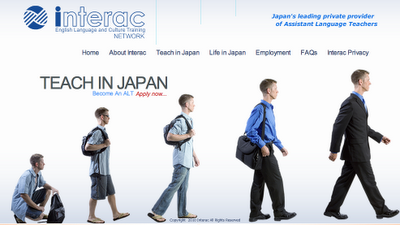
Mon, 01/25/2010 - 21:26 — ShawnDoes the company make the man? Interac seems to think so. Just think of the adventure that awaits as you are transformed from an amoeba-like university graduate into an upright-walking sensei! Um, yeah...
h/t Fucked gaijin
GEOS Tries to Spin Bad Press
Thu, 01/14/2010 - 22:47 — ShawnBack in September, The Japan Times interviewed Susumu Ikegami, a spokesman for Geos, and asked him about the eikaiwa market. To no surprise, he said business was down but for some reason could not explain why.
Four months later, this article, and the rumours swirling about the health of the company, have apparently prompted Geos to take action so to speak. What better forum to set the record straight than a puff piece in the ELT Gazette? A reader informs me that Geos "fights back" in the January issue in an article titled "GEOS rebuts crisis claims" (requires free registration to read the article).
Here's a sample of the spin that will leave you dizzy:
Geos Teaching Ltd’s human resources director Chad Lafferty, based in Japan, said, ‘Opening and closing locations is a normal part of business… The global recession has certainly impacted the way we do business, but it would be wrong to say that any closures or restructuring of the company are directly related to the recession.’
[...]
The push for better sales results is alleged to have blurred the line between sales and teaching. One former teacher, who asked not to be named, felt ‘let down by management’ and identified ‘sales skills required by teachers’ as one reason why Geos was not ‘a school a teacher could stay in for long’.
In response, Mr Lafferty stated that ‘all employees are told at the time of being hired that sales is a part of the job. They are also told that they should never make a recommendation that isn’t in the student’s best interest.’ He added, ‘The sales pressure on teachers hasn’t really increased or decreased in the past few years.’
One former Geos teacher claimed that her manager asked her to call students six months before course completion to get them to renew their contracts, and that when the company found out she was leaving, she was asked to tell students that their next teacher would be ‘good’ and to encourage them to stay.
Lafferty responded that he was ‘not aware of any teacher who has phoned a student to try and get them to renew their contracts. In fact, I’d be very strongly opposed to the idea.’ Lafferty added, ‘There is no directive from Geos saying, “You must tell your students the new teacher will be good.”’
I don't know how this quells any rumours about the health of the company or portrays Geos in a favorable manner. Lafferty didn't flat out lie in the interview, but he didn't tell the complete truth, either.
It's true that Geos tells its teachers that sales is part of the job, but he fails to say that it is a significant part of the job. It's the part of the job that reduces managers to tears and causes them to quit when they can't meet their sales targets. It is the source of angry faxes demanding that schools sell more and sign up or renew students. It's the reason why students avoid making eye contact with managers because they know if the manager nabs them, talk will inevitably be about buying more lessons.
The "there is no directive that says you must tell your students the new teacher will be good" are the words of a drone. "Yes sir! No, sir! Three bags full sir! Sell! Sell! Sell for the company!" Poor Chad Lafferty. He's sold his soul to Geos.
Fortress Japan Breaks its Agreement
Wed, 01/06/2010 - 18:13 — ShawnRemember Fortress Japan? Back in 2008, they were caught stealing a page or two out of Nova's playbook with some underhanded sales tactics. The Kansai Consumer's Support Organization (KCSO) sued, and in 2009, Fortress Japan promised to change its ways and behave.
According to the Sankei shimbun, the KSCO has asked the court in December to force Fortress Japan to pay 1.5 million yen in penalties, claiming that the English school operator broke its promise not engage in unfair sales practices.
The KSCO says that despite Fortress Japan's promise, they still told potential students that they could take lessons any time and pressured them into signing contracts. The consumer group confirmed the practices with three individuals last November and demanded that each person be paid 500 thousand yen each in compensation. Fortress Japan, however, has asked for a reprieve and has not paid the money.
Comment: What else can be said? Fortress Japan is but one example of the persistent rot in eikaiwa. Both the Mainichi and Sankei reported in November last year that complaints about the way eikaiwas (self-improvement seminars, certification courses, and computer schools were also mentioned) did business were rising. Specifically, the Sankei article reports that a typical tactic is to call a customer, usually university students, and tell them they have some useful information regarding their job hunt. Once at the school, the customer is given a guilt trip (you'll never find a job without taking English lessons) and then made to sign a contract.
The rip-off continues...
Sankei article
就活生へ不当勧誘、英会話学校に違約金求め提訴 消費者NPO
2009.12.25 11:05
就職活動中の大学生を対象に大阪や東京などで英会話や就職支援の教室を運営する「フォートレスジャパン」(東京)が、不当な勧誘をしないとした裁判上の和解条項を守っていないとして、NPO法人「消費者支援機構関西」は25日、同社に対する違約金150万円の強制執行を求める訴訟を大阪地裁に起こした。
訴状などによると、消費者支援機構関西とフォートレス社は今年3月、不当勧誘差し止め請求訴訟で和解。同社は不当勧誘の停止に合意したが、その後も「いつでも受講できる」と虚偽内容を伝えたり、威圧的に契約を迫ったりする不当な勧誘を続けた。
機構側は11月末、3人に対する不当勧誘が確認できたとして、和解条項に基づき1人50万円の違約金を請求したが、フォートレス社は猶予を求めるなどして支払わなかったという。
A Closer Look at Free Choice
Tue, 12/22/2009 - 17:22 — ShawnI'm late talking about this, but it's worth noting given Hoofin's recent comments on freechoice.jp and health insurance in Japan. After I was asked to take down a letter from a private insurance provider that I posted here, Hoofin went out and did some digging, and came up with a lot of interesting stuff.
- He found that freechoice.jp's Ron Kessler is connected to HealthOne Japan.
- In addition to HealthOne, Freechoice may also have links to other sites, including Legend Travel, Legend Travelers, and Nationalhealthinsurance.jp.
- After Hoofin starts connecting dots, Nationalhealthinsurance.jp goes offline.
If Hoofin's findings are accurate, it makes you wonder if Kessler is honestly fighting for the right for foreigners to choose between national and private health insurance schemes or if he's fighting to protect his health insurance companies or the stakes he may have in them.
The letter that I removed from the blog concluded by urging readers to visit http://www.freechoice.jp/immigration2.asp for more information.Although the page is about "breaking news," as far as I can tell, you can't access it from anywhere within freedomchoice unless you've received the letter or were told about the page by Kessler. Despite the internal fax that apparently softens Immigration's stance on having to enroll in either shakai hoken or kokumin kenko hoken, there's been no independent verification of this to my knowledge. As it stands, the revisions to Guideline 8 are still in effect and immigration offices have signs up reminding people of the changes starting in April.
Moreover, it's difficult to think that Kessler is lobbying the government for change in good faith when he writes on the main page of his website, "Free choice means having the right to choose. A non-Japanese who desires to be on public health care should also not be denied access to it." He's full of it. Foreigners are not being denied access to healthcare in Japan. It is your right and obligation to be enrolled in shakai hoken or kokumin kenko hoken If anything is wrong, it's two things: 1) ignorance by employees and 2) far too many employers, especially in eikaiwa, intentionally not informing their employees of their right to healthcare and foisting some other plan upon them that is no more than travel insurance in disguise.
Can we trust anything on the freechoice website? His claim about Guideline 8 being put on hold hasn't been verified by any other source. Given that he may have incentives to skew things toward private insurance due to his possible connections to HealthOne, the answer has to be, "No."
LJ is currently using a spam filter, which may eat legitimate comments, particularly those containing URLs. If you are having trouble posting a comment, email LJ.

Recent comments
56 min 17 sec ago
1 hour 49 min ago
6 hours 21 min ago
8 hours 6 min ago
9 hours 55 min ago
10 hours 6 min ago
10 hours 9 min ago
10 hours 17 min ago
10 hours 28 min ago
10 hours 38 min ago